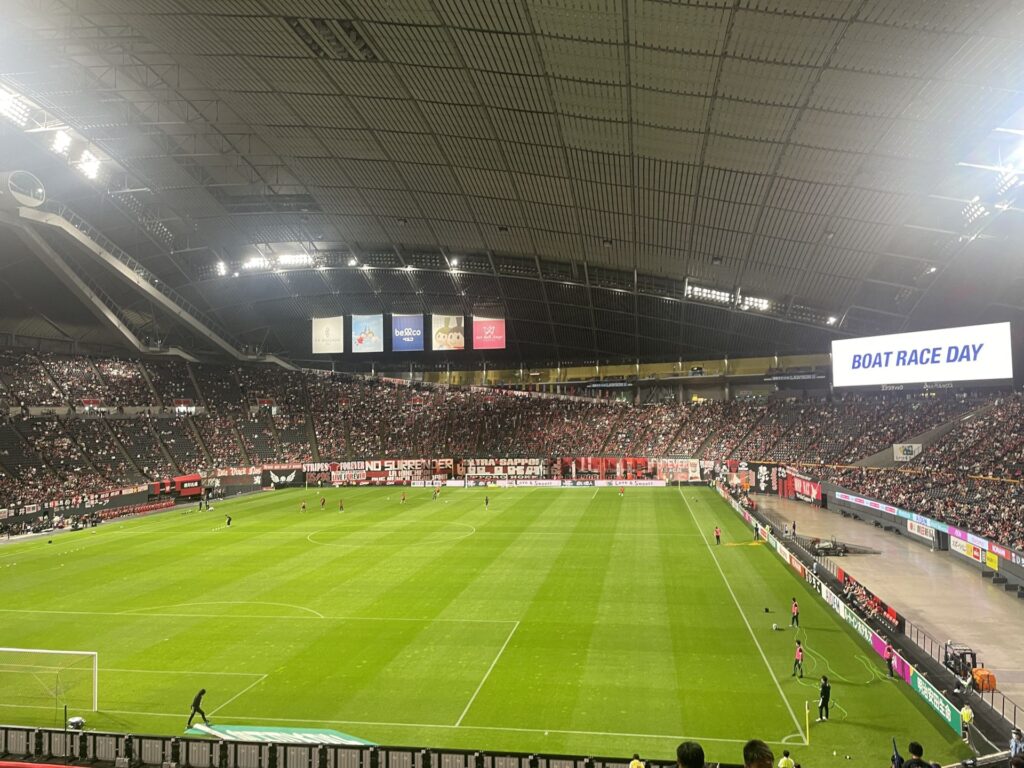
“You Can’t Call Yourself a J.League Fan Without Knowing These Head Coaches”
#1: Akira Nishino
You want to start enjoying J.League. Then first, you need to know this man. Akira Nishino. His nicknames are “Nishinon” or simply “Akira.” He has won more matches as a head coach than anyone else in J.League history.
As a Player — A Hero On and Off the Pitch
Nishino became a hero at the national high school football championship (Japan’s most prestigious tournament for under-18 players) during his school years. It was not only his performances on the pitch that made him stand out. He was also very handsome. Girls from other schools would board the same commuter trains just to catch a glimpse of him.
After developing as a player, Nishino joined Hitachi FC (a company-sponsored football club — this was a common structure in Japanese football before the J.League was founded in 1993). He also earned a place in the Japan national team.
The 1996 Atlanta Olympics — “The Miracle of Miami”
The wider world learned Nishino’s name at the 1996 Atlanta Olympics.
He was head coach of the Japan U-23 national team. In the opening group-stage match, Japan faced Brazil. That Brazil squad was called the strongest ever assembled. The roster included world-class players such as Dida (GK), Roberto Carlos, Aldair, and Bebeto.
Everyone expected Japan to lose heavily. But Nishino prepared his team with detailed opponent analysis and careful tactical planning. The final score was 1–0 to Japan.
This victory is still remembered as “The Miracle of Miami.”
As a J.League Head Coach — Gamba Osaka’s Golden Era
After retiring as a player, Nishino began his career as a head coach in J.League. He was head coach at Kashiwa Reysol, Gamba Osaka, Vissel Kobe, and Nagoya Grampus.
His ten years at Gamba Osaka (2002–2011) were the high point of his career.
Nishino’s style can be described in one phrase: ultra-attacking. He put attack before defence. He was not afraid of risk and always pushed his team forward. This style of football thrilled Gamba’s own fans. Even supporters of rival clubs felt a mix of admiration and fear when they faced his side.
From his very first season, the team was in the title race. A long run of trophy wins followed.
- 2005: J1 League champions. Runners-up in the J.League Cup (a domestic cup competition for J.League clubs, now known as the YBC Levain Cup).
- 2006: Runners-up in the Emperor’s Cup (Japan’s oldest and most prestigious national cup — open to all clubs, from amateur to professional).
- 2007: J.League Cup winners.
- 2008: AFC Champions League winners (the top club competition in Asian football, equivalent to the UEFA Champions League in Europe). Emperor’s Cup winners.
- 2009: Emperor’s Cup retained for a second year in a row.
- 2010: J1 League runners-up.
In those ten years, Nishino won the J1 League once, the J.League Cup once, the Emperor’s Cup twice, and the AFC Champions League once. He was the architect of Gamba Osaka’s golden era.
Behind the Success — Clashes with Players
The road was not always smooth for Nishino. He was stubborn. He never moved away from what he believed was right.
That belief sometimes led to serious disagreements with key players. GK Ryota Tsuzuki, DF Toru Araiba, MF Fernandinho, and MF Akihiro Ienaga were all first-team regulars who left the club at different points.
But Nishino never changed his style. And he kept winning trophies. This iron will may be the single biggest reason why he is remembered as one of football’s great head coaches.
In 2011, after two trophy-less seasons, the club chose not to renew his contract. It was effectively a dismissal. But Gamba’s supporters still hold him in high regard today.
Japan National Team Head Coach — “Ossan Japan” and the 2018 Russia World Cup
After leaving Gamba, Nishino joined the Japan Football Association as technical director (responsible for overseeing coaching appointments and player development strategy).
Just before the 2018 Russia World Cup, a serious problem arose. The Japan national team head coach at the time, Vahid Halilhodžić, was dismissed because of a breakdown in his relationship with the players. There were fewer than two months left before the tournament.
Feeling a sense of responsibility as technical director, Nishino took on the role of head coach himself.
He had very little time to prepare. To get the team working quickly, Nishino called up many experienced, older players. The media and fans mocked the squad as “Ossan Japan” — meaning “a team of old men.”
But Nishino was not shaken. He quickly built a team using the attacking football he had developed at Gamba. Japan made it through the group stage.
In the round of 16 (the first knockout round of the World Cup), Japan faced Belgium — then ranked number one in the world. Japan took a 2–0 lead. Victory seemed within reach. But Belgium scored three times in the second half and Japan lost 2–3.
Japan had fought to the very end against the world’s best. That performance left a lasting impression on many fans.
His Record and Legacy
After the World Cup, Nishino became head coach of the Thailand national team. He was dismissed two years later and has not coached a side since.
His 270 wins as a J1 League head coach are the all-time record. No head coach has broken this record to this day.
Akira Nishino is essential to the story of J.League. His deep belief in attacking football, his ability to make decisions under pressure, and his mental toughness through repeated conflicts with players and clubs — all of these are the reasons he is called one of the great head coaches.
“If you want to call yourself a real J.League fan, start by knowing Akira Nishino.”
Next time: J.League Great Head Coaches Series, #2 — stay tuned.